
Bottom line. A manager can hold outcomes steady only in proportion to the responses they have. Ashby proved this in 1956 by counting: the variety that survives in the outcome is at least the variety of disturbances divided by the variety of responses. Twelve kinds of problem against three kinds of response guarantees at least four distinct outcomes, and only one of those is the one anybody wanted. No amount of effort, seniority, or working late closes that gap. Modern engineering organizations have multiplied the kinds of problem arriving while leaving the manager’s list of responses roughly where it was. There are exactly two fixes, and both are structural. Reduce the variety that reaches you, by filtering, aggregating, or refusing. Or increase your distinct responses, mostly by giving other people the authority to respond without you. Working harder is not a third option, because it applies the same responses faster.
A thermostat has two moves. It can call for heat or stop calling for heat. That is everything it can do, and against the problem it was built for, a room getting colder than a set point, two moves are enough.
Now add disturbances. Someone opens a window. Humidity climbs. One room faces west and bakes in the afternoon while another stays cold all day. A heat pump ices over. The thermostat still has two moves. It is not broken, it is not miscalibrated, and no amount of tuning the set point will help, because the number of distinct situations it faces has passed the number of distinct responses it can make. Past that line, the thermostat stops being a controller and becomes a spectator with an opinion.
W. Ross Ashby, a British psychiatrist, worked out the general form of this in 1956 and stated it in six words: only variety can destroy variety.
What variety means
Variety is the count of distinguishable states a system can occupy. A coin has a variety of two. A six-sided die, six. A team of eight engineers, each of whom might be blocked, waiting on review, mid-refactor, on call, or heads-down, occupies a state space in the thousands before anything unusual happens.
Ashby’s law, in his own framing, sets up three things. There are disturbances, D, arriving from the environment. There are essential variables, E, that have to stay within an acceptable range for the system to survive. And there is a regulator, R, whose job is to act so that whatever D does, E stays inside that range.
The law says the variety in the outcome cannot be driven below the variety in the disturbances divided by the variety in the regulator. Written out: V(E) is at least V(D) divided by V(R). Put plainly: divide the number of problems by the number of responses, and that answer is how many different outcomes you get. Twelve kinds of problem against three kinds of response leaves at least four distinct outcomes, when the goal was exactly one.
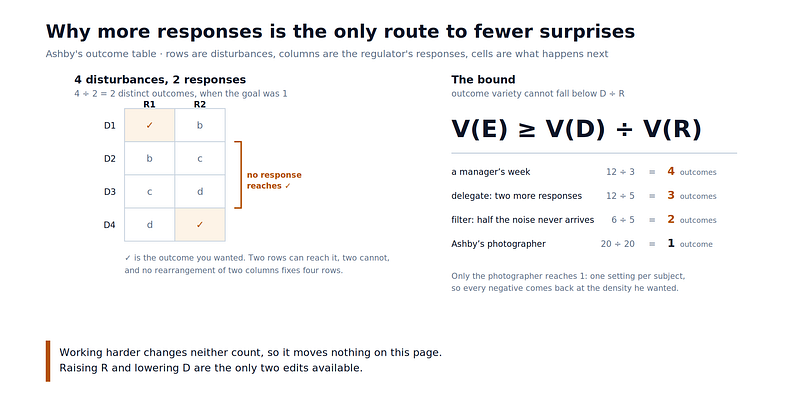
The table is the proof in miniature. Lay the disturbances out as rows and the available responses as columns, and each cell holds whatever the world does when that response meets that disturbance. To hold the outcome steady, every row needs at least one cell containing the outcome you wanted. With four rows and two columns, two rows have one and two do not, and rearranging the columns moves the problem without solving it. The shortfall is structural.
This is a counting argument rather than a heuristic, and counting arguments don’t negotiate. Three responses can’t hold twelve situations to a single outcome through effort, seniority, or good intentions, for the same reason 30 feet of paint cannot cover a 40-foot wall.
The press photographer, Ashby’s own illustration
Ashby knew the law sounds trivial once stated, and he said so in An Introduction to Cybernetics: in its elementary forms, he wrote, it is intuitively obvious and hardly deserving statement. The example he reached for to make it concrete, in section 11/13 of the book, is the one worth borrowing, because a camera’s settings are easier to count than an organization.
Ashby’s photographer has twenty subjects to shoot, all different in exposure and distance. If every negative is to come back at uniform density and sharpness, the camera must have at least twenty distinct settings. Nineteen settings leave one subject uncovered, no matter how skilled the photographer. The twentieth arrives, there is no setting for it, and that negative comes back wrong.
That is the entire law, in Ashby’s own illustration. Mapped onto his formal terms: the photographer is the regulator, the subjects are the disturbances, uniform density is the essential variable held in range, and the camera settings are the responses. Nothing about the situation changes if the photographer is talented, experienced, or working overtime.
Ashby also drew a tighter formulation worth carrying: a regulator’s capacity as a regulator cannot exceed its capacity as a channel of communication. He connected this directly to Shannon’s tenth theorem, which limits the noise a correction channel can remove to the information that channel can carry. Regulation and error correction are the same problem in different clothes.
A note on a claim often attached to Ashby here. The widely circulated passage arguing that the law refutes concentrating power in a central authority comes from an editor’s introduction to an online excerpt of An Introduction to Cybernetics, not from Ashby’s text. The centralization argument may follow from the law, but Ashby did not make it in that passage, and it gets quoted as though he did.
The manager as regulator
Ashby wrote about organisms, machines, and cameras rather than engineering teams, but the counting argument does not care what the regulator is made of. Take the law to an engineering organization and the mapping is direct. The environment produces disturbances: production incidents, shifting requirements, a dependency team missing a date, attrition, a security finding, a customer escalation, an architectural decision that needs to be made this week. The essential variables are the things that must stay in range for the org to remain viable, delivery predictability, system reliability, retention, cost. The manager is a regulator.
And a manager has a fixed and rather small set of distinct responses. Reprioritize. Reassign someone. Escalate. Add process. Ask for headcount. Change a deadline. Absorb the work personally. That is close to the whole list, and the last one counts as a single response, because a person can only be in one place at a time.
Now count the disturbance side of a modern team. Six engineers, each running two or three agent sessions, each session producing changes fast enough that review is the bottleneck. Microservice architectures where a change in one system surfaces as a failure in another. Dependencies on teams in other time zones. A dozen tools each generating alerts. The disturbance space of an engineering organization has expanded by orders of magnitude in twenty years. The manager’s list of responses has expanded by roughly nothing.
That gap is Ashby’s inequality, unsatisfied, rather than a personal failing. When a manager says they are drowning, they are usually reporting a variety deficit with great precision.
The two moves, and only two
Because it is arithmetic, the remedies are constrained. There are exactly two, and Stafford Beer, who spent a career applying cybernetics to real organizations, named them: attenuation and amplification. He called the deliberate combination of them variety engineering.
Attenuation reduces the variety arriving at the regulator. You take a complex environment and make less of it reach you, by filtering, aggregating, categorizing, or refusing. A dashboard does this. So does an on-call rotation, an escalation policy, a standard architecture. Each one shrinks the number of distinct situations that require a distinct decision from you.
Attenuation costs less and carries more risk, because there are two ways to do it. You can genuinely reduce the variety, or you can stop perceiving it and hope the part you chose not to see does not matter. A dashboard that shows four numbers has attenuated a thousand-state system into four states. Whether that is regulation or self-deception depends entirely on whether the four numbers carry the states that matter, which is the argument of Goodhart’s law arriving from a different direction.
Amplification increases the variety of the regulator. You gain more distinct responses. Delegating authority does this at the largest scale, because every engineer empowered to decide without asking is a second regulator, with their own responses, working in parallel. Automation does it: a runbook that handles a class of incident without a human is a response you now have that you did not have before. Cross-training does it. Better instrumentation does it, since a response you cannot trigger because you cannot see the trigger does not count.
Between these two moves sits every real structural decision a manager makes. Reorganizations, platform investments, on-call design, decision rights, tooling. They are all variety engineering, whether or not anyone frames them that way.
The corollary that stings
Eleven years after the law, Ashby and Roger Conant published a theorem with a title that reads like a provocation: every good regulator of a system must be a model of that system.
The formal claim is narrower than the title suggests, and worth stating carefully because it gets overquoted. The theorem shows that a regulator which is both optimal and maximally simple must be a homomorphic image of the system it regulates. Later work has pointed out that it establishes this for the simplest optimal regulators rather than for every good regulator, and that the mapping is a homomorphism rather than an isomorphism, meaning the model can lose information about the thing it models. The original assumptions are also strong: full observability, deterministic mappings.
Discount it appropriately and the direction of the result still matters for a manager. Effective control requires an internal model of the thing being controlled, and the model’s fidelity caps the regulation’s quality. A manager whose mental model of their system is a list of team names and a roadmap has a low-variety model, and will regulate as well as that model permits, which is to say badly, and with confidence, since a wrong model produces decisions that feel correct.
Stated less comfortably: when a manager is repeatedly surprised by their own system, the surprises are measuring model fidelity. Each surprise is a state the system could occupy that the model did not contain.
What this predicts
A law is worth something if it tells you what to expect. Ashby’s produces several predictions that are checkable against any organization.
Adding people to a struggling team often makes regulation harder, not easier, because headcount raises the variety of the system being regulated faster than it raises the variety of the regulator.
Process added under pressure usually attenuates the wrong thing. Written under time constraint, it filters what is easy to filter rather than what is noisy, and the untouched variety continues arriving.
A manager who is the single point of decision for a fast-growing system will become the constraint, regardless of talent. Talent raises the number of responses by some factor. Growth raises the disturbance space by more.
One failure mode looks like diligence: a manager who responds to rising variety by working longer hours is amplifying throughput, not variety. Same responses, applied faster. The unmatched states still pass through.
Where AI sits in this
Agent-assisted engineering is a variety event on both sides of the inequality at once.
On the disturbance side, it multiplies states. More changes in flight, more review decisions, more surface area, more ways to be wrong, arriving faster. Every measurement of the last two years shows the queue moving to review, which is a variety problem stated in queueing language: more distinct things needing a distinct human judgment than there are human judgments available.
On the regulator side, it is the first genuine amplifier of managerial variety in a long while. A system that triages alerts, drafts the first review pass, summarizes a hundred incidents into five patterns, or answers questions that used to require the one person who knows, adds distinct responses to the list. Not throughput. Responses.
Which side wins is a design decision rather than a property of the technology. An organization that adopts agents to produce more changes and adds no review and verification capacity has amplified only the problem side, and has made its variety deficit worse with every efficiency gain. That is a coherent explanation for why teams report feeling faster while shipping slower.
Using it
Count the disturbances. For one month, log every distinct kind of thing that required a decision. Not the volume, the kinds. Most managers find between twenty and fifty categories, which is already a hard number to look at next to the next one.
Count the responses. List the genuinely distinct moves available, and be strict about it. “Work harder” is not a response, it is the same responses applied longer. Most lists come out under ten.
Then the design work, which is choosing per category: attenuate or amplify. Some disturbances should never reach you, and building the filter is a week of work that pays for years. Some need a new response added, usually meaning someone else gets the authority to make that call. A small number are genuinely yours and always will be.
Holding both counts constant and pushing harder leaves the inequality where it was. It counts responses, not commitment.
By Joshua McDonald on August 18, 2026.
Reader discussion