
There are two two types of motivation, intrinsic and extrinsic. Intrinsic motivation comes from within. It’s something you do for the love of doing it, something you would without a reward. Extrinsic motivation, on the other hand, is something that you do for any other reason — most of us will think of bonuses or pay when asked for an example of extrinsic motivation. The prevailing thought is that extrinsic motivation in the workplace can drive results, but is that really the best way to create an environment where innovation thrives?
Let’s take a look at extrinsic motivation in the workplace. Companies often try to gain productivity from employees by structuring bonus plans, compensation and incentives. They then revert to a tried and true transactional leadership style, where leaders provide these monetary awards to employees to advance their own goals. This works because it’s in the interest of the employee to do what the leaders want. You could argue — and you would be right — that in some lines of work such as sales, which are inherently motivated by financial rewards, this transactional leadership style would effectively accomplish what the leader set out to do. I only have to think back twenty (or so) years to my days in car sales, when there was a strong financial incentive to add rustproofing, extended warranties and in-house financing, to see the effectiveness of this approach. To be clear, the example above is based on contingent reward. There is another, darker side to transactional leadership which is known as management-by-exception. This is centered around negative feedback, criticism and negative reinforcement. If you have ever felt micromanaged, then you have experience with this style of leadership.[1]
The problem here is that work for many people has evolved to be more creative, where many organizations are staking their success on the ingenuity and resourcefulness of their employees. In these types of organizations, a top-down approach, which lends itself to a transactional leadership style, simply will not work, as it relies on those at the top having all of the answers. This is not how innovation works — innovation thrives when those innovating are intrinsically motivated to solve the hardest problems or create remarkable products.
It’s impossible to talk about motivation without touching on Abraham Maslow, who pioneered motivational theory.
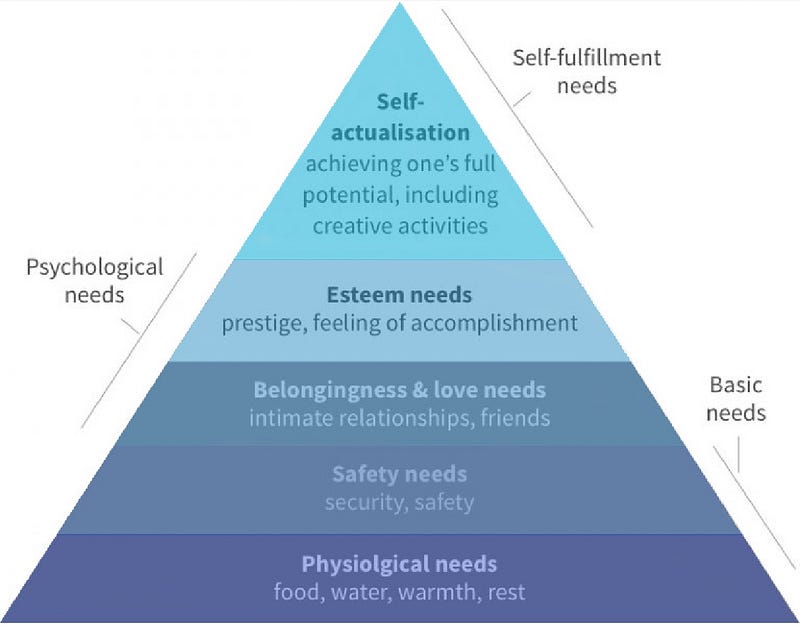
This theory centers around the idea that everyone is striving to reach a state of self-actualization. Maslow constructed the hierarchy of needs, which is often pictured as a pyramid. The hierarchy starts with basic needs such as physiological needs, which include food and water; then it moves toward safety, which includes physical and financial security as well as health. Next comes relationships, family and love, followed by esteem, or the need for respect and confidence. Finally, at the top of the pyramid comes self-actualization, or the ability to accomplish everything that you can.
Assuming you pay people well and all of their basic needs are met, then what? How do you foster an environment where people show up to tackle the hard problems for the sake of tackling the hard problem? If you get a chance to read Patty McCord’s book Powerful, please do. The title of the first chapter is “The Greatest Motivation Is Contributing to Success,” and I really do believe that is true.
McCord goes on to say that “Great teams are not created with incentives, procedures, and perks. They are created by hiring talented people who are adults and want nothing more than to tackle a challenge, and then communicating to them, clearly and continuously, about what the challenge is”. [2]
This sounds a lot like transformational leadership, which according to Peter Northouse, leads to performance beyond expectation. Transformational leadership consists of four factors: idealized influence, inspirational motivation, intellectual stimulation and individualized consideration.
Leaders who exhibit idealized influence are those who serve as role models. They have high standards and are trusted and respected by followers. They articulate a vision and communicate it clearly and continuously. In addition, inspirational motivation describes leaders that communicate high expectations often through encouragement. This type of communication leads to team cohesion and higher morale. In fact, in a survey of followers that appeared in Tom Rath and Barry Conchie’s book Strengths-Based Leadership, participants were asked to name which leader had the most positive influence in their daily lives. Participants were then asked to list three words that best describe what this person contributed to their lives. Followers consistently named trust, compassion, stability and hope. The third factor is intellectual stimulation, which comes from the type of leader that embraces discovery and encourages the team to think and act on its own while solving problems. [1]
Leadership matters, and transformational leadership that fosters intrinsic motivation is critical to the success of any organization that is striving to test the limits of hard problems using creativity, reasoning and experimentation. Organizations should take a look at how they structure bonus and compensation plans to ensure that they are not unintentionally altering the culture to a degree where it starts to block innovation. As business and leadership speaker Kylie Sprott states, “There is no substitute for good leadership and a truly engaging culture”. [3]
Finally because we are all followers, Maslow stated that **“**If you deliberately plan to be less than you are capable of being, then I warn you that you’ll be deeply unhappy for the rest of your life. You will be evading your own capacities, your own possibilities.”
[1] Northouse, P. G. (2013). Leadership: Theory and practice (6th ed.). Thousand Oaks: SAGE.
[2]McCord, P. (2017). Powerful: Building a culture of freedom and responsibility: From the co-creator of NETFLIX culture deck. S. l.: Silicon Guild.
[3] Kylie Sprott Executive | Director | Advisor | Speaker | Business Transformation Leader. (n.d.). Retention Bonuses — what do they really say about your culture? Retrieved August 02, 2020, from https://www.linkedin.com/pulse/retention-bonuses-what-do-really-say-your-culture-kylie-sprott/
By Joshua McDonald on August 3, 2020.
Reader discussion