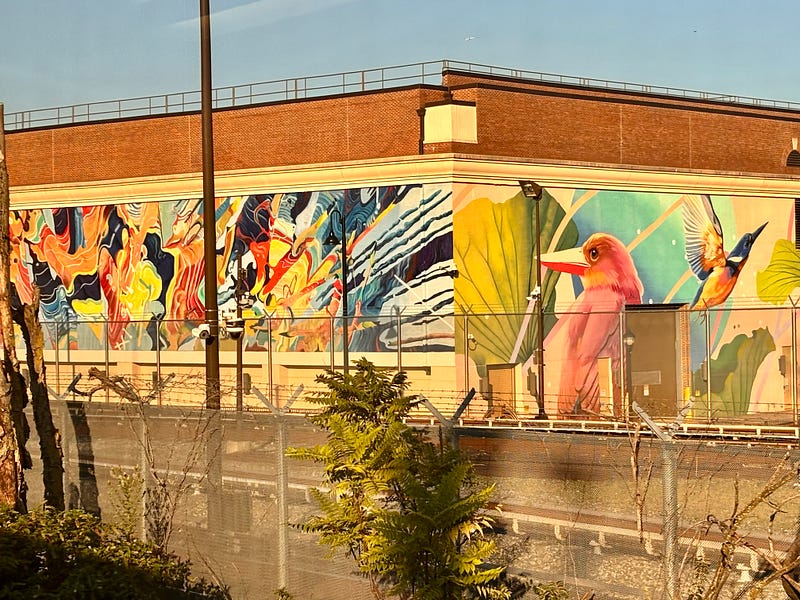
Clarksburg sits at the far northwest corner of Montgomery County, Maryland, about thirty-five miles from downtown DC and eleven from the Shady Grove Metro park and ride, the last stop on the subway line. Everyone living north of it drives. Two decades of construction turned the old crossroads into subdivisions and several thousand houses whose owners work somewhere else, with a strip of chain restaurants out by the outlet mall. The development stops at the northern edge of town. Fields and silos run from there to the Frederick County line.
The suburbs between Clarksburg and the district have no edges. Development runs unbroken from the District line through Bethesda, Rockville, Gaithersburg, and Germantown, thirty miles of townhouses and biotech campuses without a field between them.
Northbound I-270 leaves the Capital Beltway six lanes wide, split into two roadways: local lanes on the outside for drivers exiting soon, three express lanes and an HOV lane on the inside for everyone headed farther. Past Falls Road the highway carries more than 250,000 vehicles a day. The count then falls in steps. The local lanes end north of the MD 124 interchange in Gaithersburg and their traffic merges left. At Middlebrook Road the road narrows to three lanes and the HOV lane. Anyone who started at the Beltway has already been squeezed twice before reaching Germantown.
Just past the MD 121 overpass at Clarksburg, the right lane ends and the HOV restriction ends with it. Three lanes become two. The road runs north from there as a four-lane freeway, two in each direction, at a 65 mph speed limit, through farmland and past a weigh station, all the way to Frederick.
Traffic stops at that merge on weekday evenings. It also stops on Saturday afternoons and Sunday evenings, when there is no commute. The southbound side runs the same stretch in reverse: the two-lane section fills in the morning, the backup extends north of it, and the queue dissolves at Clarksburg where the road widens again. One segment of pavement sets the rate in both directions.
That puts the same six-lane stretch on both sides of the constraint depending on the hour. It sits upstream in the evening and downstream in the morning, and each position wastes money in a different way.
Northbound in the evening, the wide section feeds the merge. Cars reach Clarksburg at whatever rate three lanes deliver and leave at whatever rate two lanes accept. Widening anything south of the merge delivers drivers to the back of the same queue sooner.
Southbound in the morning, the wide section takes whatever the two-lane segment releases. Traffic thins as soon as the road opens up at Clarksburg, and the lanes south of there carry well below what they could. The constraint starves them. Another lane anywhere along that stretch would be pavement the two-lane segment never fills.
Neither kind of spending reaches the output number, since money upstream of a constraint piles work in front of it while money downstream buys capacity that waits to be fed.
This is the fourth piece in a series on the laws that govern how engineering organizations behave. The first three explained why organizations slow down: a serial fraction that caps speedup, queues that convert hours of work into weeks of calendar, and coordination costs that turn growth negative. This one covers what to do about it.
Throughput belongs to one stage
Total output equals the output of the tightest stage. Every other stage runs faster than the system does, and the excess capacity produces nothing.
Take a pipeline of five stages with capacities of 100, 90, 40, 85, and 95 units per hour. Total output is 40 units per hour. Double the first stage to 200 and output holds at 40. Improve all four non-constraint stages by half, at whatever cost in money and disruption, and output still holds at 40. The number moves when the third stage moves, and at no other time.
Stages one and two hold the same position as the evening traffic north of Rockville, and stages four and five hold the position of the morning traffic south of Clarksburg. Improving the first pair pushes additional work into the queue in front of the constraint, where that work sits and ages until someone finds the defects buried in it. Improving the second pair adds capacity to stages already waiting on deliveries that never speed up. The plant runs harder and ships the same amount. Eliyahu Goldratt spent a career explaining why.
A physicist writes a novel
Goldratt was an Israeli physicist who moved into manufacturing software and kept finding plants that ran badly in ways their managers could describe accurately and still not correct. In 1984, he published the argument as a novel, written with Jeff Cox, whose collaboration with Goldratt began at Westinghouse in 1982.
The Goal follows Alex Rogo, a plant manager at UniCo, who is given three months to turn his plant around or see it closed. A former professor named Jonah asks him questions instead of answering them. Rogo works out the theory over the course of the book, most memorably on a Boy Scout hike where the troop keeps stretching apart and he realizes the column moves at the speed of Herbie, the slowest boy, no matter how fast the leaders walk. Rogo moves Herbie to the front of the column and redistributes the weight in his pack among the faster boys, which raises the pace of the whole troop.
The book has sold more than seven million copies, appeared in more than thirty languages, and been revised three times, most recently for a fortieth anniversary edition. Time included it in a 2011 list of the twenty-five most influential business management books. The novel form carried the argument to readers who would not have opened a book about bottleneck scheduling.
The five steps
Goldratt distilled the method into five steps, which he called a process of ongoing improvement.
Identify the constraint. One stage limits the system. Find it before doing anything else. In a plant, look for the station with work piled in front of it and idle stations downstream. On a highway, look for the point where speed collapses on a Sunday.
Exploit the constraint. Extract everything possible from the constraint before spending money on it. A bottleneck machine should never sit idle through lunch breaks and shift changes. It should never receive defective parts that it processes and the next station rejects. Low-value work belongs somewhere else entirely. Goldratt’s summary of the step: an hour lost at the bottleneck is an hour lost for the entire system, while an hour saved at a non-bottleneck is a mirage.
Subordinate everything else to the constraint. Run every other stage at the pace the constraint can absorb, which means deliberately running them below capacity. Managers refuse this step more than the other four combined.
Elevate the constraint. Add capacity. Buy the second machine, hire into the bottleneck role, build the lane. This step comes fourth, after the cheap options are exhausted, because elevation costs the most and often turns out to be unnecessary once exploitation is done properly.
Repeat, and do not let inertia become the constraint. Break one constraint and another takes its place somewhere else. The policies built around the old constraint outlive it, and an organization that keeps optimizing for a bottleneck it already fixed has replaced a physical limit with a procedural one.
Why subordination gets refused
No capacity spreadsheet rewards the third step. It asks a manager to leave capable people and expensive equipment deliberately underused.
A manager whose team runs at 60 percent looks like a manager who needs fewer people, so the team finds work to fill the gap, and the work it finds flows toward the constraint and waits there. Measured utilization improves while delivered output stays flat.
Kingman’s formula, from the second piece in this series, supplies the defense. Waiting time explodes as any stage approaches full utilization, multiplied by how variable the arriving work is. A non-constraint stage has slack to absorb that waiting, so it never reaches the output number. At the constraint there is nothing to absorb it. Slack everywhere else costs nothing real and protects the one stage that cannot recover a lost hour once an upstream hiccup starves it.
Goldratt built this into a scheduling method he called drum-buffer-rope. The constraint sets the pace, the drum. A buffer of work sits in front of it so it never starves. A rope ties the release of new work at the front of the line to the constraint’s consumption, so the system stops flooding itself with material it cannot process. Little’s Law, from the same earlier piece, describes what the rope accomplishes: less work sitting in the system, and a shorter trip through it at unchanged output.
What Maryland actually did
The lane drop at Clarksburg has been studied for decades, and the responses to it track Goldratt’s first four steps.
In 2017 the state announced an Innovative Congestion Management program for the corridor: more than twenty-five signs relaying real-time traffic information, more than thirty smart traffic signals, cameras, and ramp meters controlling the rate at which cars enter the highway. By late 2019 the program was reported at 46 percent complete. In 2020 the state started a $2.7 million geometric improvement between MD 121 and MD 109, extending an acceleration lane.
Ramp metering exploits the constraint without adding a foot of pavement. It regulates the rate of arrivals so that merging traffic does not tip the through lanes into stop-and-go, and a highway in stop-and-go carries fewer vehicles per hour than the same highway rolling steadily at 45. Protecting the constraint’s effective capacity is the same job the buffer does in front of Herbie.
At the other end of the price range sits the elevation step: a $5 billion proposal to widen I-270 and the Beltway with toll lanes, which received federal environmental approval in 2022. Years later it remains largely unbuilt, with engineering money still in the state’s capital plan and construction repeatedly deferred. Whatever its merits, the timeline illustrates Goldratt’s ordering: the exploitation work shipped within three years for single-digit millions, while the elevation work has run most of a decade at a thousand times the price without adding a lane.
The constraint in an engineering organization
The bottleneck is rarely where the roadmap assumes, and three candidates cover most cases.
Review capacity. Code generation has gotten dramatically cheaper while the number of people qualified to review a change in a given system has not moved. Pull requests queue up and then collide with each other as they age. Exploitation here means taking everything off the reviewer’s plate that a machine can check, then keeping changes small enough to finish in one sitting.
The release process. A single release train with one deploy window and a manual regression pass in front of it. Every team funnels through that gate, which makes it both the serial fraction from the first piece in this series and the constraint from this one. Cutting everything from the critical path that does not have to be there exploits what exists. Automating the deploy elevates it, so that releases stop being events.
The one person who knows. A single engineer understands the payments system, the data pipeline, or the legacy service that everything depends on. Every project touching that area queues behind that person’s attention. Exploitation means protecting their calendar ruthlessly and routing only constraint-worthy work to them. Elevation means deliberate knowledge transfer through pairing and written documentation, which takes months and is the only fix that holds.
In all three cases the diagnostic question holds: where does work pile up, and which stage sits idle waiting for it? A pile with idle capacity behind it marks the constraint.
The constraint moves
Fix review capacity and the release process becomes the bottleneck. Automate the release and the constraint moves to a shared platform team, then to a decision that only one committee can make, then to something else. This is expected. Goldratt’s fifth step exists because the answer changes.
Policy outlives the limit that produced it. An organization that spent two years optimizing for review capacity keeps those review policies after the constraint has moved, and those policies now slow a system whose bottleneck is somewhere else entirely. The weekly architecture review that once protected a scarce reviewer becomes a queue in its own right. Nobody removes it, because it was the right answer recently and removing things requires someone to argue that a past decision has expired.
Where to start
Find the pile. Walk the delivery path for the last ten things that shipped and note where work waited longest. The stage with a queue in front of it and idle capacity behind it is the constraint. One pass through the data will usually settle a question that months of debate did not.
Exhaust the cheap options before asking for headcount. Most constraints run at a fraction of their theoretical capacity because they get interrupted and handed work that never needed them in the first place. Recovering that capacity usually takes a few weeks of scheduling changes.
Then subordinate deliberately, and say out loud that certain teams will run below capacity on purpose, because the alternative is that they fill the gap with work that goes straight into a queue. Set the release rate to what the constraint can absorb rather than to what the front of the line can produce.
And put a date on the reassessment. The constraint will move once it is fixed, and the policies built around it will stay in place until someone argues for removing them. Six months is a reasonable interval to walk the delivery path again and find out where the pile went.
By Joshua McDonald on August 2, 2026.
Reader discussion